From Workarounds
to Workflow
Learning from User Behaviour

Role
Experience Design Consultant
Tasks
Requirements Gathering, Research, Analysis
Background
Change Request Forms
The Change Request Form (CRF) allowed advisors to report account-level software issues (e.g. a disabled button preventing a sale) within the call centre software.
Once submitted:
- The CRF team investigated the issue.
- The request was returned to the advisor as either "Resolved" or "Rejected".
- Status updates appeared in 'My CRFs' table on the home screen.
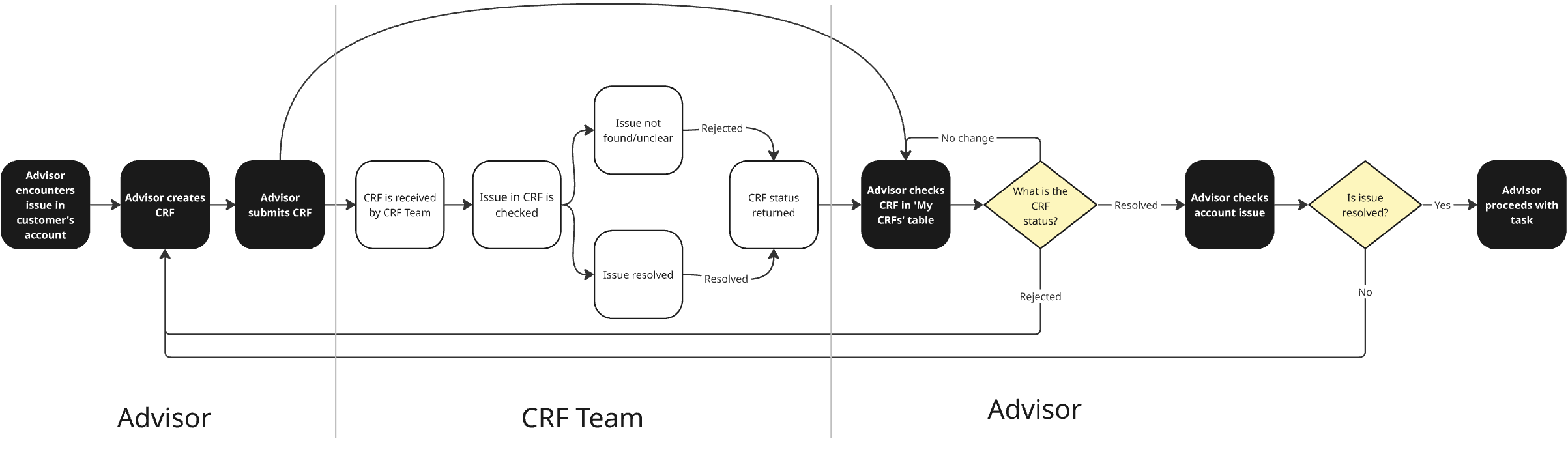 CRF operational task flow.
Problem
Critically, the 'My CRFs' table sat outside of the customer account view, meaning advisors had to leave their workflow and manually navigate to the home screen to check for updates.
This inefficiency affected approximately 6,000 advisors across all estates, resulting in lost productivity, increased operational costs, delays in customer resolution, and a suboptimal user experience.
Research
Ethnographic research (Call Centres)
In-person observation sessions across multiple estates revealed something more valuable than our users' frustration.
Advisors had built their own workaround using an in-built notification tool to remind themselves to check CRFs.
This was a key insight into our users' needs, so I proceeded to map the workaround.
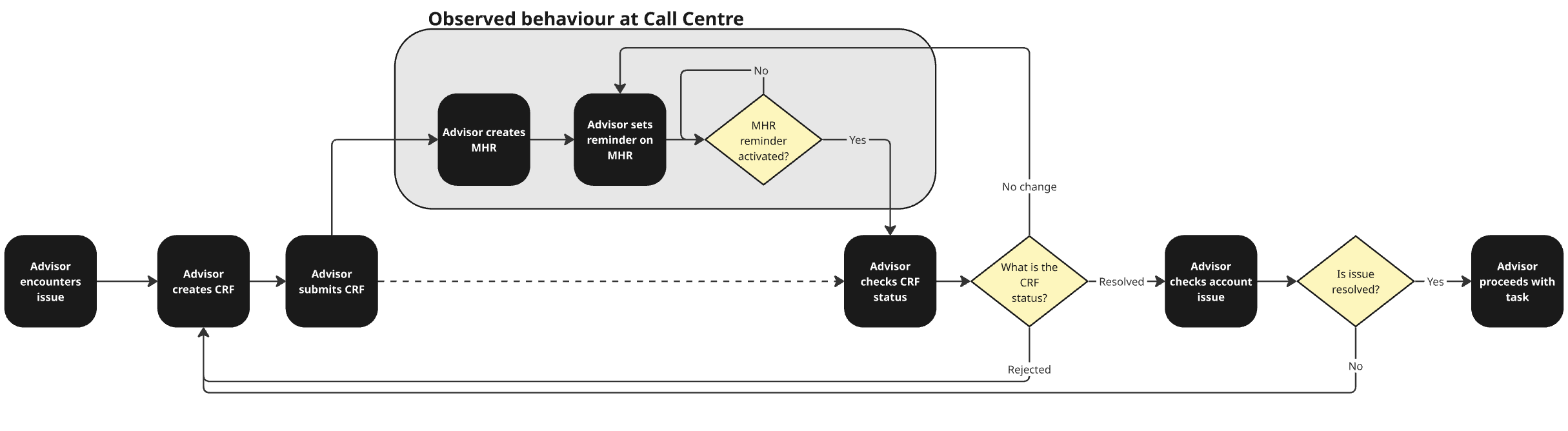 User flow of workaround observed at call centres.
User Interviews
One-to-one interviews surfaced consistent themes:
- Raising CRFs was straightforward.
- Tracking them was frustrating and inefficient.
- Rejections felt unclear and resolutions delayed.
- Customers were often left waiting without updates.
Much of the frustration related to operational processes beyond digital scope. These were escalated appropriately, but I focused on identifying high-impact, in-product opportunities.
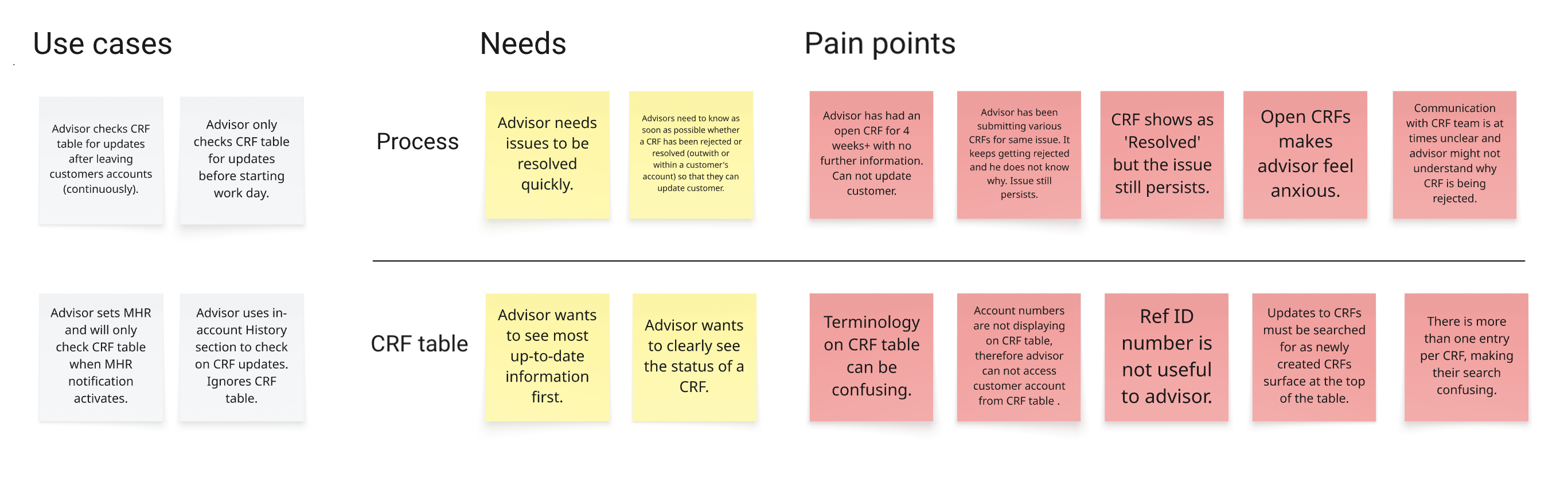 Notes from user interviews.
Seeking value
Through effort vs value mapping, we identified:
- Quick wins within the 'My CRFs' table.
- A higher-effort, higher-impact opportunity: real-time notifications.
Despite implementation complexity, research, specifically the insight into the workaround our users' were using, strongly supported notifications as the behavioural solution.
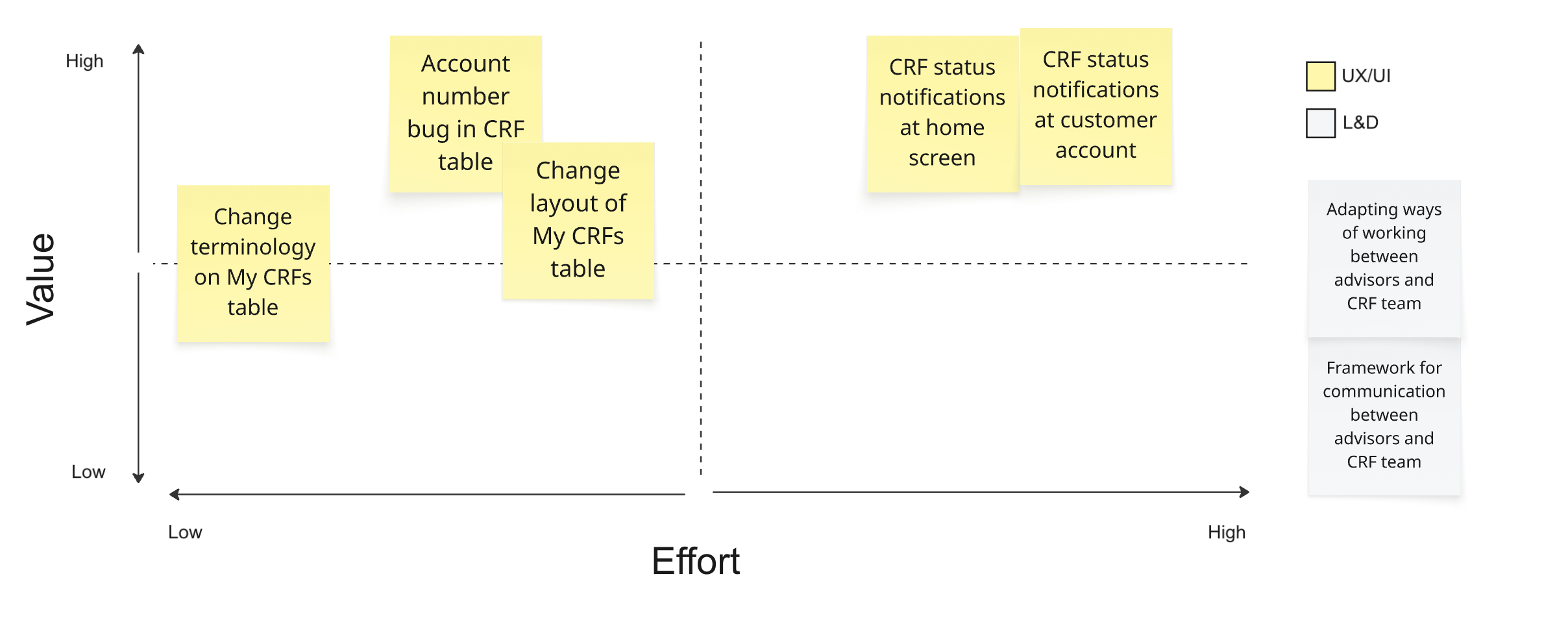 Effort vs Value Matrix.
Design Outcomes
Redesigning the 'My CRFs' Table
Research exposed usability, clarity and functionality issues.
I iterated on multiple design solutions, grounded in research insights, and tested these designs with advisors at call centres.
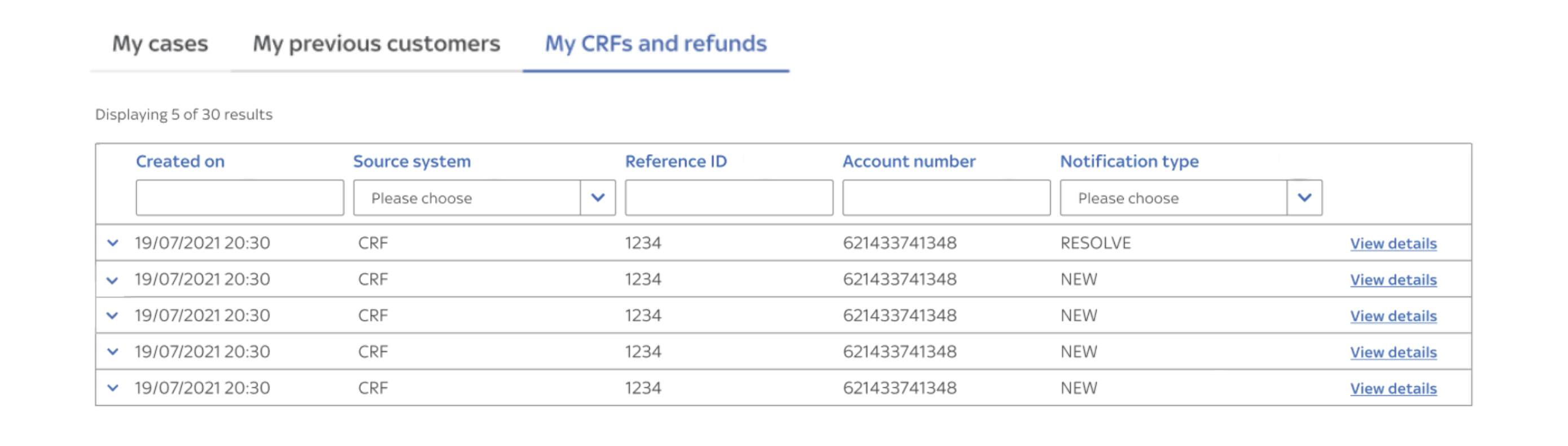 'My CRFs' table before redesign.
Final improvements included:
- A red badge alerting users to updates on menu tab and on row entry.
- Terminology adapted for column titles and CRF status, increasing clarity.
- Default order changed to display latest CRF update first.
- Addition of date sorting to facilitate searching for CRF entries.
- Visual distinction of new (unopened) CRF notifications.
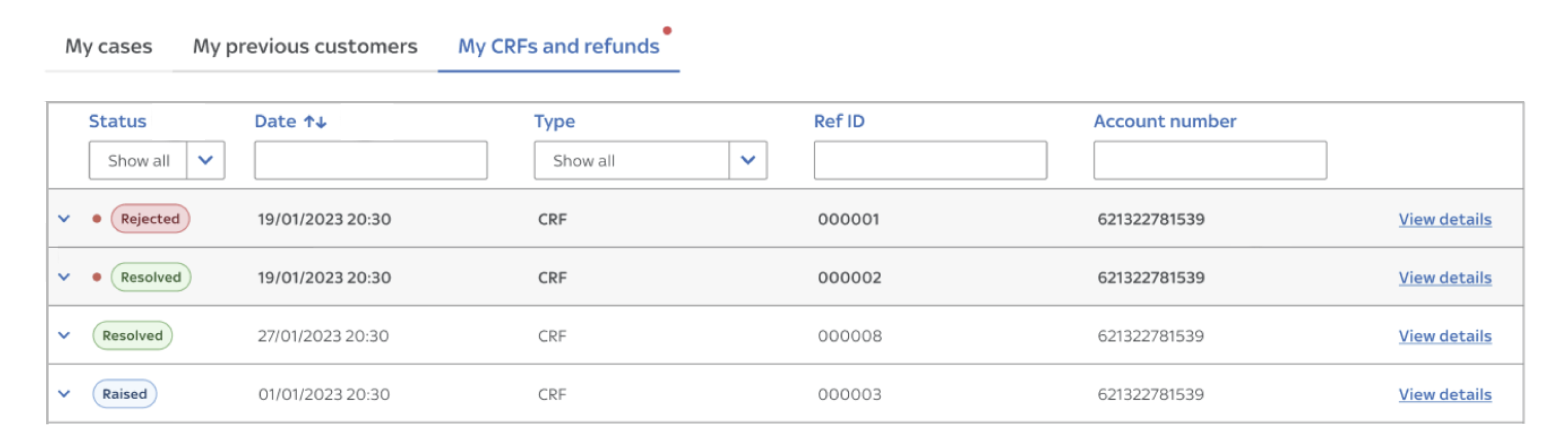 'My CRFs' table after redesign.
Introducing In-Account Notifications
Observation showed advisors spent the majority of their time inside customer accounts, not on the home screen. To ensure adoption and success, CRF notifications needed to work in this context.
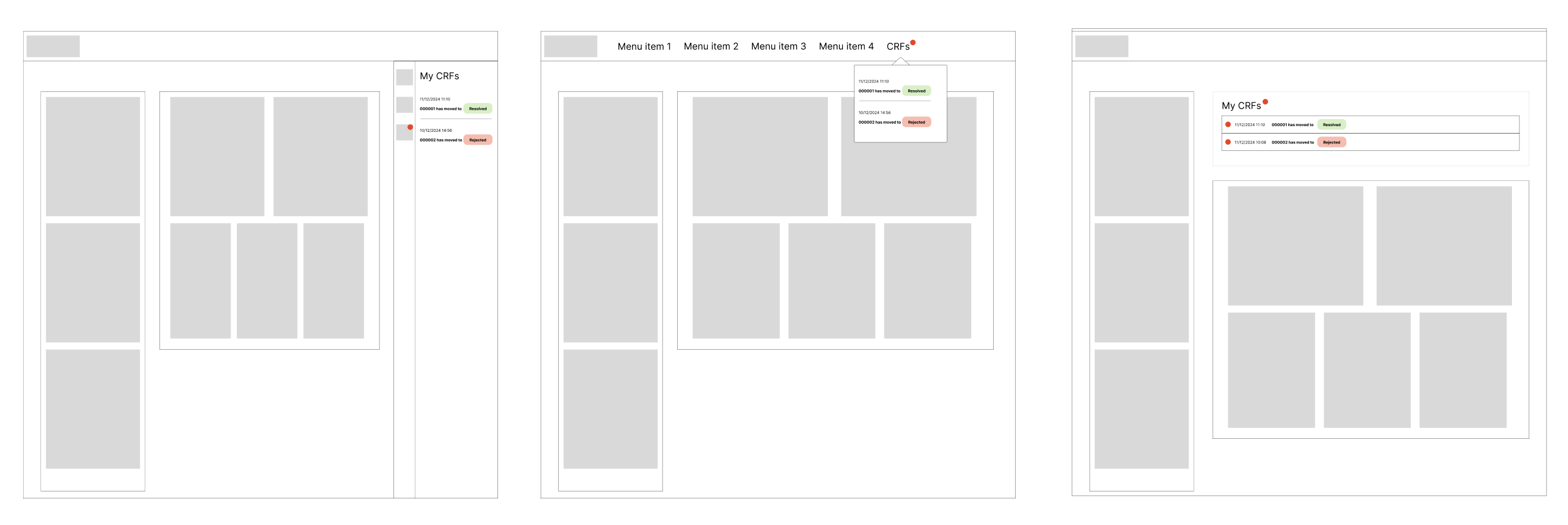 Design iterations for CRF in-account notifications.
User testing revealed that a persistent sidebar notification pattern was the most effective approach.
Key Design Features:
- New 'My CRFs' icon within account sidebar
- Red badge alerting to status changes.
- Notifications for both “Resolved” and “Rejected” states.
- Visibility without forced interruption.
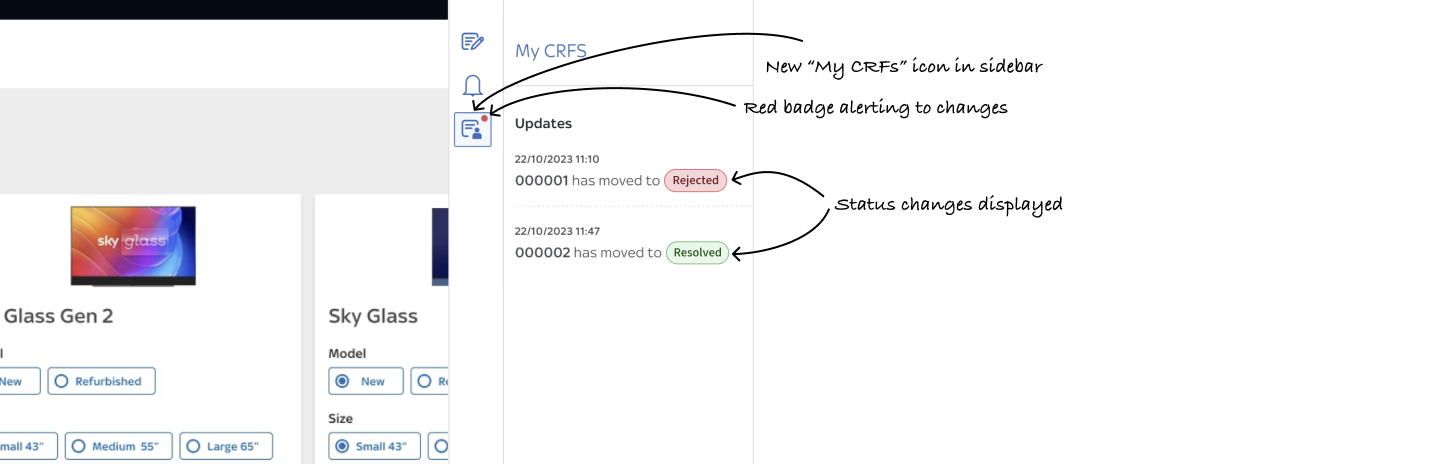 High fidelity prototype of proposed CRF in-account notifications.
Results
Quantitative Data
Tracking was implemented pre-deployment, allowing us to measure behaviour shift with confidence.
65% decrease in time spent on CRF table.
£600k annual savings through increased efficiency.
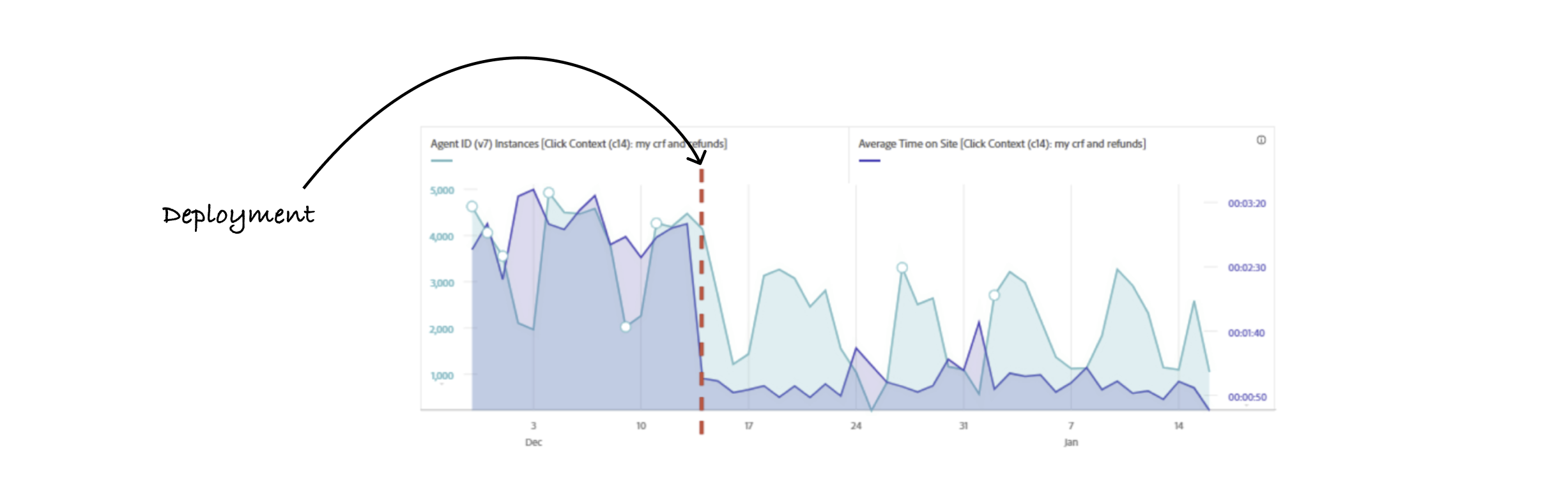 Adobe Analytics displaying behaviour changes at call centres.
Qualitative Data
Post-deployment, follow-up field research confirmed:
- Reduced friction.
- Greater sense of control.
- Improved ability to “stay on top” of workload.
- Sales advisor
Outcomes
- Advisor experience improved significantly through in-software notifications and table enhancements.
- Data showed a clear shift in user behaviour.
- The business benefited from reduced non-productive time and measurable financial savings.
This project demonstrates:
- The commercial value of ethnographic research.
- How behavioural observation reveals unmet needs.
- The power of aligning solutions with existing mental models.
- The importance of embedding design within operational realities.
The shift was not just UI improvement, it was a behavioural redesign of workflow.
Recommendations (Beyond the Initial Scope)
Through research, further opportunities were identified:
- Introduce clearer status states (“Received”, “In Progress”).
- Improve CRF team ↔ advisor communication framework.
- Increase visibility of CRF process changes. Awareness gaps were identified post-implementation.
Extending influence further into the end-to-end service would unlock even greater value.
Takeaways
- Observation is critical for uncovering unmet needs and unspoken pain points.
- A holistic, end-to-end view often reveals opportunities beyond initial scope. Extending design influence further into the E2E process could unlock even greater value for users and the business.